The Dave Saviet Collection
|
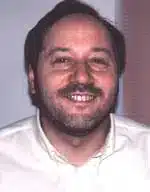
Dave Saviet began his career in broadcasting at WRKL, a 1KW daytimer in Mt. Ivy, New York, in the mid '70's.
Since 1978, Dave's been busy as a technician for the CBS Network in New York City. He says he's been fortunate to have worked with the best in the business, like Charles Osgood, Charles Kuralt, Doug Edwards, Dan Rather and many others. He engineered Walter Cronkite's 20th Century for a number of years and worked with Dan Ingram and Cousin Bruce Morrow, to name a few.
In addition to the impressive collection of airchecks that Dave is sharing with Repository visitors, he also collects classic 45's and QSL's. Dave says that in his years with CBS he's had so many wonderful assignments that it would take a book to list them all. He also says that he has been very fortunate to not to have moved all over the country, like many broadcasters. We are very fortunate to have Dave's collection available in the Repository. Thank you, Dave! |
[Descriptions by Uncle Ricky]
This somewhat verbose (but enjoyable) presentation was obviously created to showcase the success of Buzz Bennett and KCBQ, San Diego. It could rightfully be considered a “mini-history of popular music radio” as it attempts to define the “secrets” and formatics of “Drake” and “Progressive” Radio.In 1971, it was easy to disparage the original production elements of Top 40, and the narrators bash many of them, and then proceed to provide a short-form bio of Bill Drake, and his “well-oiled machine”.
Beginning with a decade of Los Angeles radio including KFWB, Bill Ballance, KRLA, Dave Hull, KHJ, Robert W. Morgan, Frank Terry, and Mike Turner on “underground” KMET, it concludes with Rich Brother Robbin and Shotgun Tom Kelly on KCBQ, San Diego.
The authors of this exhibit were identified within minutes of the opening! Ken Levine and Billy Pearl are responsible, and the initial report of authorship is available via COMMENT. (Thanks, Ken!)
WHTZ (Z-100) and The Morning Zoo inspired many (mostly inferior) imitators in the 80’s, but none came close to the professionalism and creative genius of the original. This composite was a 1985 Billboard Magazine Award winner.
Some were under the impression that all you needed for a “Morning Zoo” was a crowd of people in the control room every morning, but Scott Shannon, Ross Brittain and the other (often celebrity) participants in the Z-100 Zoo set new (sometimes shocking) standards for mass-appeal music morning shows.
Steve O’ Brien was filling in for Ted “Bear” Richards on this Solid Gold Weekend in 1974.
Much has been written about “The Big 8” (mostly at Jack Decker’s Classic CKLW Page) and every complimentary word is true. Masterfully engineered, always powerful and perfectly polished – this monster station was some of the best American Top 40 ever imported from Canada!
The Big 8 and O’Brien sounded great together.
In the opening hours of 1960, just a few months before a May 1960 grand jury indictment on charges of accepting payola, Peter Tripp hosted “The Fabulous Forty of 1959” on WMGM, New York City.The smooth-talking Tripp, who later worked at KYA and WHN, passed away January 31, 2000.
I was surprised at the consistent formatics in this rare aircheck. Note the WMGM “time chime” jingle – which followed every record! Years later, that formatic was to appear again at WABC.
[Description by Uncle Ricky]
This aircheck of portions of a Dan Ingram Saturday morning show on KBOX in Dallas is from December, 1959. It’s probably a few months older than the Repository’s first Dan Ingram KBOX aircheck, which was circulated in the ’70’s via Programmer’s Digest. This one is longer and the fidelity is marginal, but the content is fabulous. KBOX was always heavily produced and that’s clearly demonstrated with this exhibit.
As has been pointed out before, Ingram was already very, very good in 1959  he just wasn’t in New York, yet. Following KBOX, Ingram was at WIL in St. Louis.
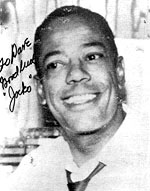
Douglas Jocko Henderson headlines this two-part exhibit from the WCBS-FM Radio Greats Reunion of June, 1995. Jocko is joined by one-time Cleveland DJ Eddie O’Jay for most of the show. A cameo appearance by Dan Ingram is featured in Part One. Jocko’s son Doug Henderson, Bobby Jay and Jimmy Castor are heard in Part Two. All but two of the recorded commercial announcements have been removed, but the live reads by Jocko and O’Jay are intact. Throughout the three hours, Jocko promotes and demonstrates his Get Ready Accelerated Learning Package, which uses rap and rhythm to help children pay attention in school.

Jocko Henderson &
Leo Rogers, Record PromoterJocko Henderson said he was neither “the imitator nor the duplicator, but the originator.” In the ’50’s, the Ace from Outer Space would commute from Philadelphia to New York’s WOV (later WADO) nightly. He hosted shows at the Apollo Theatre in Harlem and at Loew’s State, Broadway’s first rock & roll review. His Rocket Ship Show at the Apollo was legendary. Wires suspended him from the ceiling, and he would fly onto the stage in a rocket with theatrical smoke, rapping for his audience. Jocko’s Rocket Ship Show was a nod to one of his idols, Hot Rod Hulbert, who had worked in Henderson’s home town of Baltimore.
Jocko Henderson passed away at the age of 82, on July 15, 2000. He would have been 77 for this 1995 Radio Greats appearance, which was his last. It features a few musical rarities and lots of the fast-talking rhymes and “googa mooga” for which he is remembered.